

PrismaX: The Quiet Infrastructure Play Behind Mainstream Robotics

Introduction
My mom has a cleaning robot.
And it’s... dumb. Like, really dumb.
It regularly gets stuck under the sofa. It runs over stuff (including a fairly expensive gadget I left lying around! RIP). It always gets lost in our house and rarely finds its way back to its charging dock without someone hunting it down like it’s gone rogue.

And I kept thinking, this is 2025. We’ve got robots doing synchronized flips in Boston Dynamics videos. There are fleets working warehouses at Amazon. We’re training LLMs on trillions of tokens. Why can’t a home robot clean up without causing chaos?
That question stuck with me. So I went down the rabbit hole.
Imagine if that cleaning robot were actually smart. I don’t mean “mapped the room once and prays you don’t move the couch” smart.
I mean adaptive, learning, context-aware smart.
What if it learned the layout of our home over time, not just static geometry, but the patterns of clutter? What if it recognized the difference between a sock and a charger cord, and navigated accordingly? What if it understood that its battery level meant it needed to wrap up and head home, not die quietly under the bed?
We like to talk about AGI and humanoids, but we haven’t nailed the basics. That disconnect fascinates me.
I recently read a quote on X that hit home:
“Robots can do backflips. But they still can’t fold your laundry. Why? It’s not a hardware problem, it’s a data problem.”
— Bayley Wang, Founder of PrismaX, on The People’s AI Podcast
Couldn’t agree more.
Of course, right after that, someone shared a video of a robot folding towels in a hotel and asked, “What about this then?”
Fair point. But here’s the thing: most of those videos are heavily scripted. Hardcoded routines. Zero generalization. That towel-folding bot doesn’t know what a hoodie is, let alone how to handle tangled bedsheets on a rainy day in a cramped Tokyo apartment.
That’s the core of what PrismaX is solving, and why I think this is one of the most exciting bets in robotics right now.
Let’s unpack what Bayley and the team are building (spoiler: it’s not just “smarter robots”), and how crypto-native coordination might be the missing puzzle piece to scale it beyond R&D labs.
LLMs vs. Robotics: Why the Rules Are Different

Language models have it easy.
They train on trillions of tokens scraped from the web. Everyone’s using the same internet soup, fine-tuned in slightly different ways. It's compute-heavy, but coordination-light. Once you’ve got GPUs and a dataset, you’re in the game.
Robotics isn’t like that.
There is no massive public dataset of robots doing useful, real-world tasks. No Common Crawl of laundry folding, dish loading, or hallway navigating. Every piece of data has to be collected: manually, deliberately, and usually with real-world stakes.
And that changes everything.
In LLMs, the bottleneck is compute.
In robotics, the bottleneck is data, and not just volume, but the right kind.
That’s why general-purpose robotics hasn’t scaled the way language models have. It’s not about sensors or motors. It’s about teaching robots the patterns of the physical world, and we’re only just starting to figure out how.
This is the context PrismaX is stepping into.
What is PrismaX
PrismaX is a robotics project that… doesn’t build robots?
Sounds crazy. It’s not.
While most robotics players are busy fine-tuning humanoids for warehouses or perfecting humanoid demos, PrismaX is different. Rather than chasing industrial contracts, they're building the platform that could make robotics truly mainstream.
That means:
Not just warehouse automation, but real-world autonomy.
Not just factories, but homes, streets, kitchens, and classrooms.
Not to replace people, but to work with them.

PrismaX focuses on unlocking the everyday potential of autonomous robots. Think less “billion-dollar robot dog” and more “can my robot handle the chaos of a lived-in apartment?”
Their thesis is bold: The real blocker to robotics isn’t hardware, it’s infrastructure. Specifically, the data infrastructure needed to make robots useful, adaptive, and widely accessible.
PrismaX recently came out of stealth with $11M raised, backed by heavyweights like a16z CSX, Stanford Blockchain Builder Fund, Symbolic, Volt Capital, and Virtuals Protocol.
Co-founded by Bayley Wang and Chyna Qu, the team blends deep robotics expertise with decentralized coordination, which is precisely what’s needed to tackle the hardest part of scaling physical AI: how to collect high-quality, diverse, and affordable data at global scale.
Because autonomy may be moving into the real world, but the data rails to support it are still catching up.
In the next section, we’ll unpack how PrismaX is building that infrastructure, and why it might just be the missing layer between robots in the lab and robots in your life.
PrismaX Is Building the Missing Layer in Robotics
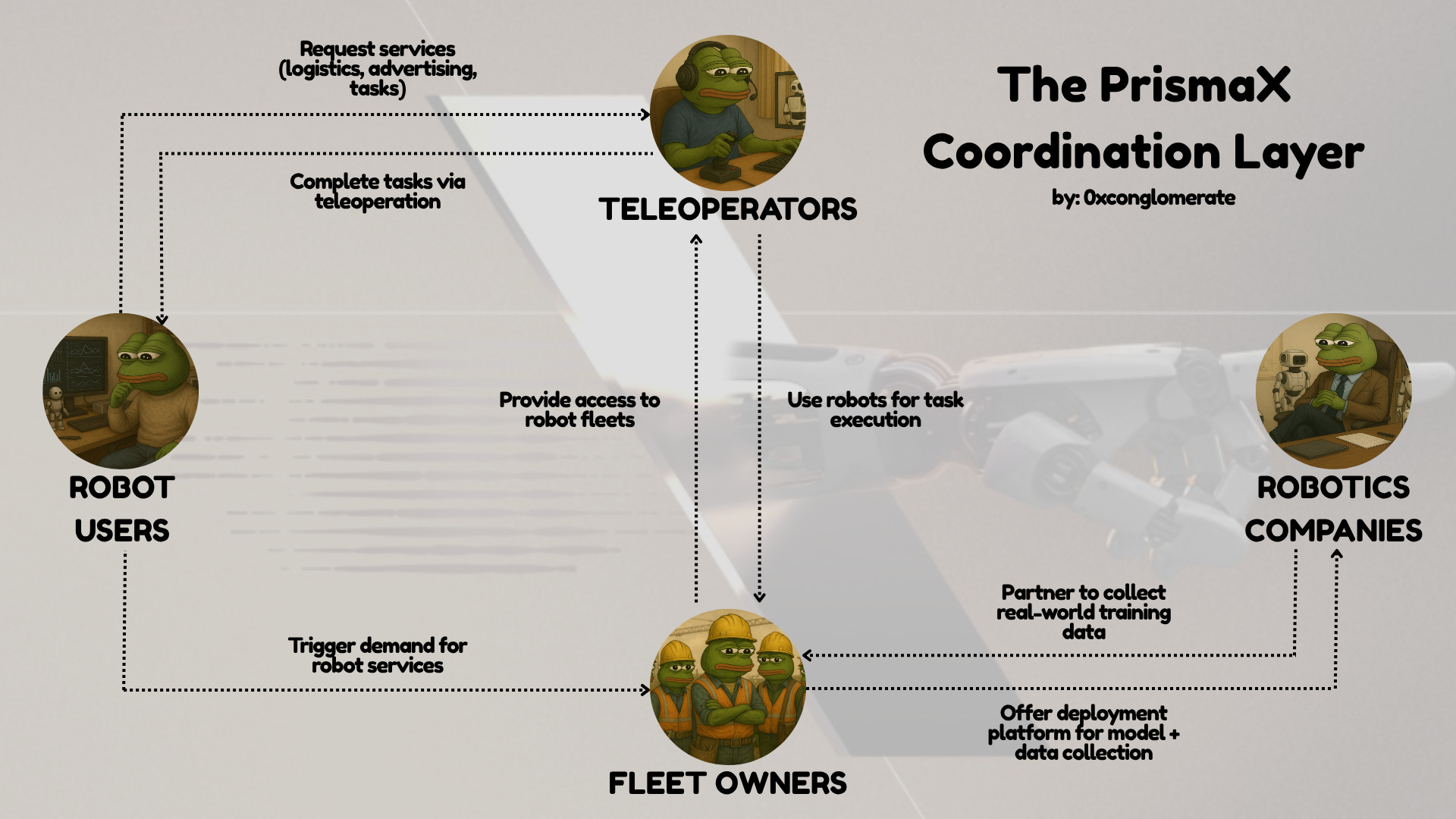
PrismaX is building the system that makes intelligent machines matter: the coordination layer that connects people, fleets, and data into one shared network.
At the center of it all are four key players:
Teleoperators – people who remotely control robots.
Robot Users – businesses or individuals who need tasks done.
Fleet Owners – those who invest in and manage robot hardware.
Robotics Companies – the ones building smarter models.
Here’s how the ecosystem flows:
Operators connect with Users and Fleet Owners to complete real-world jobs, like warehouse logistics, cleaning, or content creation, while generating high-quality data.
Users request services knowing there’s a real person guiding the robot when needed.
Fleet Owners get a way to monetize their hardware, either through task-based earnings or by selling data.
Robotics Companies tap into this data to train better AI models, without sinking time into hardware or burning through capital.
Everyone plugs into the same system. Everyone benefits.
That system is powered by three tightly linked pillars: Data, Teleop, and Models. Together, they form a flywheel that gets smarter and more valuable every time someone picks up a joystick or a robot does its job.
1. Teleop → Make Robots Useful Today

Robots aren’t fully autonomous yet, and that’s okay.
That’s why teleoperation, robots controlled by humans, is still essential. PrismaX builds the infrastructure to do it at scale: global access to tasks, built-in payments, and a protocol that rewards speed and precision. Operators can stake tokens for higher-rep jobs, join local guilds for specialized tasks, and earn bonuses for high-performance sessions.
It’s a system designed for today’s reality, and every session feeds valuable data right back into the network.
2. Data → Internet-Scale, Robot-Grade
LLMs have Common Crawl. Robotics? Not even close.
PrismaX changes that. Every teleop session generates rich data: video, behavior, sensor context. The Eval Engine scores it automatically, and the best data gets listed in a decentralized marketplace.
Some data is network-owned (open, tokenized, resellable).
Some is customer-owned (private and premium).
Either way, contributors get rewarded, and buyers know what’s high-quality. Visual data is the highlight here, since it scales passively, doesn’t need custom hardware, and unlocks massive downstream value.
Over time, this becomes the Internet Archive for physical intelligence.
3. Models → Smarter Every Task, Better Every Loop

Robots used to be expensive one-time purchases. PrismaX turns them into income-generating machines.
How? By partnering with top AI teams to build models that run inside the network. Those models boost robot autonomy, meaning one operator can handle multiple bots. That increases productivity, generates better data, and improves the models again.
It’s a feedback loop, with robots treated like network miners. They earn by collecting premium data, completing real-world tasks, or even passively mining tokens during downtime.
More robots = more data = better models = even more useful robots.
What This Looks Like in the Real World
So what does all of this actually look like when it’s working?
First, there’s the teleop stack: fully open-source and built so robot builders don’t have to reinvent the wheel. They just plug in PrismaX’s APIs, and suddenly their robots are network-ready. On the other side, operators anywhere in the world can log in from a browser or hop into VR, instantly connected to jobs. Everything from discovery, trust, payments is handled through PrismaX’s on-chain backend, without messy integrations.
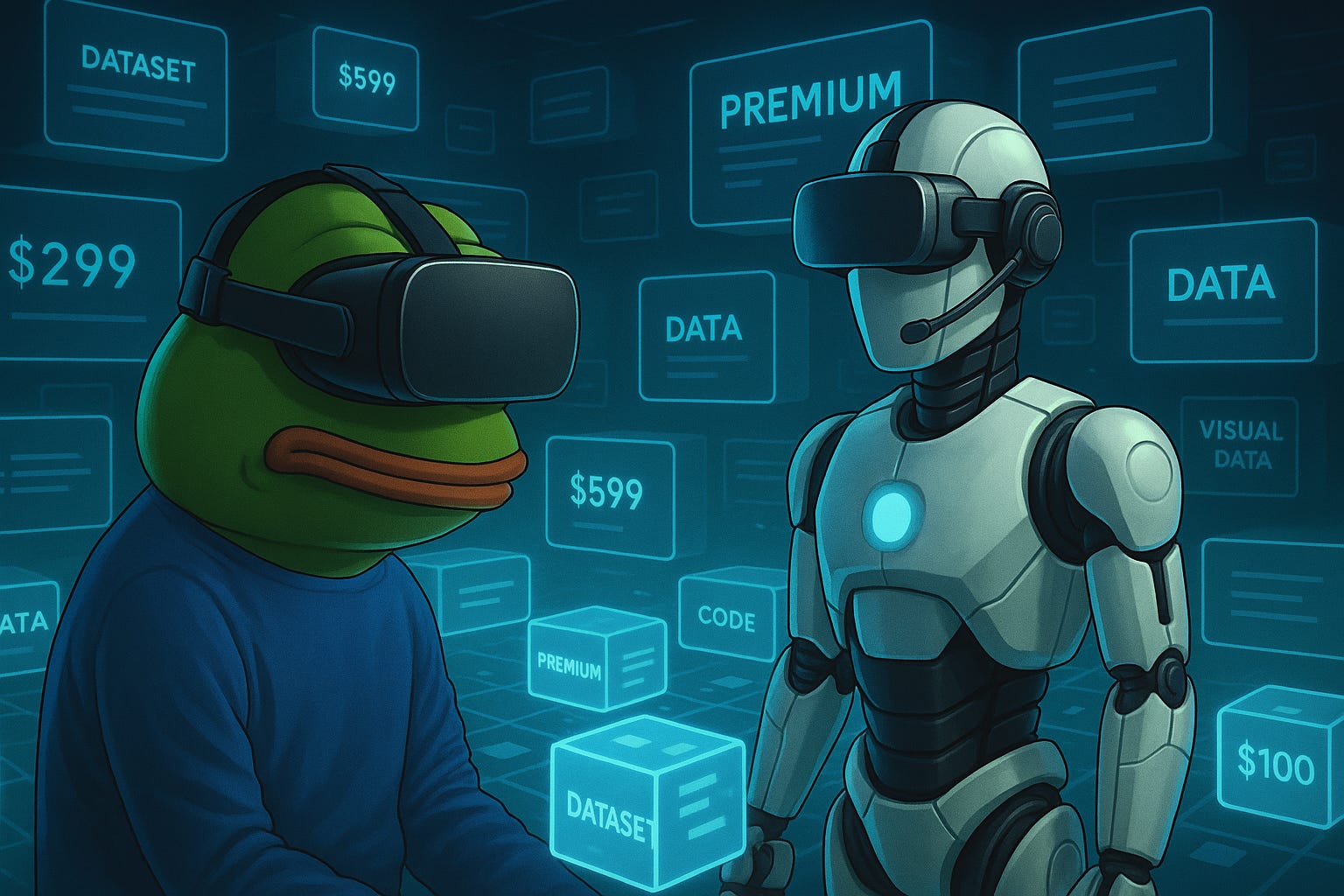
Then there’s the data engine, and this part’s kind of wild. Instead of relying on stale, hardcoded datasets, PrismaX taps into a living, breathing network of real people collecting fresh data on demand. Need a specific type of warehouse footage or sidewalk obstacle trace? You can request it via API. Or just browse the marketplace, where the Eval Engine automatically scores, filters, and prices everything.
Finally, it all ties together in the marketplace, a real economy where robot users, owners, and operators meet. Maybe someone needs a robot to deliver items at a trade show. Maybe another’s got three bots sitting idle in a storage unit. Maybe a local guild of operators is crushing high-precision teleop work. The PrismaX marketplace connects them, handles the logistics, and keeps everything transparent. You can even start thinking beyond human tasks: robot-to-robot coordination is on the roadmap.
Conclusion
We started with a dumb cleaning robot. One that runs over cables, gets stuck under sofas, and dies in the hallway like it’s giving up on the job entirely. That little machine isn’t broken because of bad hardware, it’s broken because it doesn’t understand the world it’s in. It doesn’t learn. It doesn’t adapt. And it definitely doesn’t get smarter over time.

Every robotics startup loves to talk about “data,” but very few actually build the rails to make it flow. I’ve lost count of how many projects say you can “contribute to training,” only to find there’s no real infrastructure behind it. PrismaX is different because of its actual systems: a global teleop layer, a real data economy, and incentives that make robot ownership viable from day one.
Robotics won’t go mainstream because of a viral clip of a robot doing backflips. It’ll happen when the right systems are in place. If PrismaX delivers on what they are building, the next time my mom buys a cleaning robot, it might actually know how to clean.
Not because it was smarter at launch. But because it had somewhere to learn.
About Conglomerate
Conglomerate is a seasoned content writer and KOL in the crypto x AI x robotics space. Web3 gaming analyst, core contributor at The Core Loop, and pioneer of the onchain gaming hub and Crypto AI Resource Hub.
Book A Call
Curious how robotics, gaming, and AI can drive your next growth wave? Let’s talk. Book a call with Crescendo’s BD lead Filippo