

Teleoperation & Crypto: The Missing Link in Scaling Real-World AI

Introduction
It started with Iron Man 3.
I still remember how mesmerized I was watching Tony Stark control his suits from afar, calling them piece by piece, guiding them like extensions of his own body. At the time, it felt like a wildly futuristic idea. Remote control, but on an entirely new level.
In the earlier Iron Man films, Tony was always inside the suit. He was the pilot, the weapon, the target. Every battle put his life directly on the line. One wrong move and he’s toast.
But in Iron Man 3, something changed. He began to separate himself from the danger, operating the machines without physically being inside them.

I always assumed that kind of tech was pure fiction. But as I started digging deeper into AI and robotics, I realized that that cool tech movie we used to think was just make-believe is starting to exist in real life. The gap between Marvel tech and modern robotics is narrowing fast.
I also think about J.A.R.V.I.S., Stark’s ever-present AI assistant. Back then, it felt like a magical idea: a voice-controlled, all-knowing digital partner that could control your entire environment and help manage machines on the fly.
Fast forward a decade, and we’ve already got Alexa. Google Assistant. Siri. Voice interfaces used to feel like a novelty: turn off the lights, play your playlist, change the thermostat, but for a moment, they made us feel like Tony Stark.
And then came ChatGPT. Suddenly, we weren’t just issuing commands, we were having conversations. The assistant could reason, explain, reflect, and talk back! That was my personal J.A.R.V.I.S. moment. Except it wasn’t in a movie. It was real.
But I’m not here to talk about Iron Man, or voice assistants, or AI companions. I recently came across a $14,550 wearable Iron Man MK7 suit online.
It looked legit with lights, motors, even an automated faceplate.
But beyond the flashy suit? Nothing. No flight, no remote control, no JARVIS.
I can’t help but wonder, how far are we really from that level of technology? Is the infrastructure even close to making something like that possible, not the suit itself, but the system behind it?
Teleoperation, Explained
How close are we to J.A.R.V.I.S.?
Closer than you think.
We already have drones that carry out missions from halfway across the world. Bomb disposal robots rolling into danger zones while their human operators remain safely behind screens. Surgeons in New York performing operations in Dubai through robotic arms. Machines that extend human reach, not by being autonomous, but by being remotely controlled.
Welcome to the world of teleoperation.
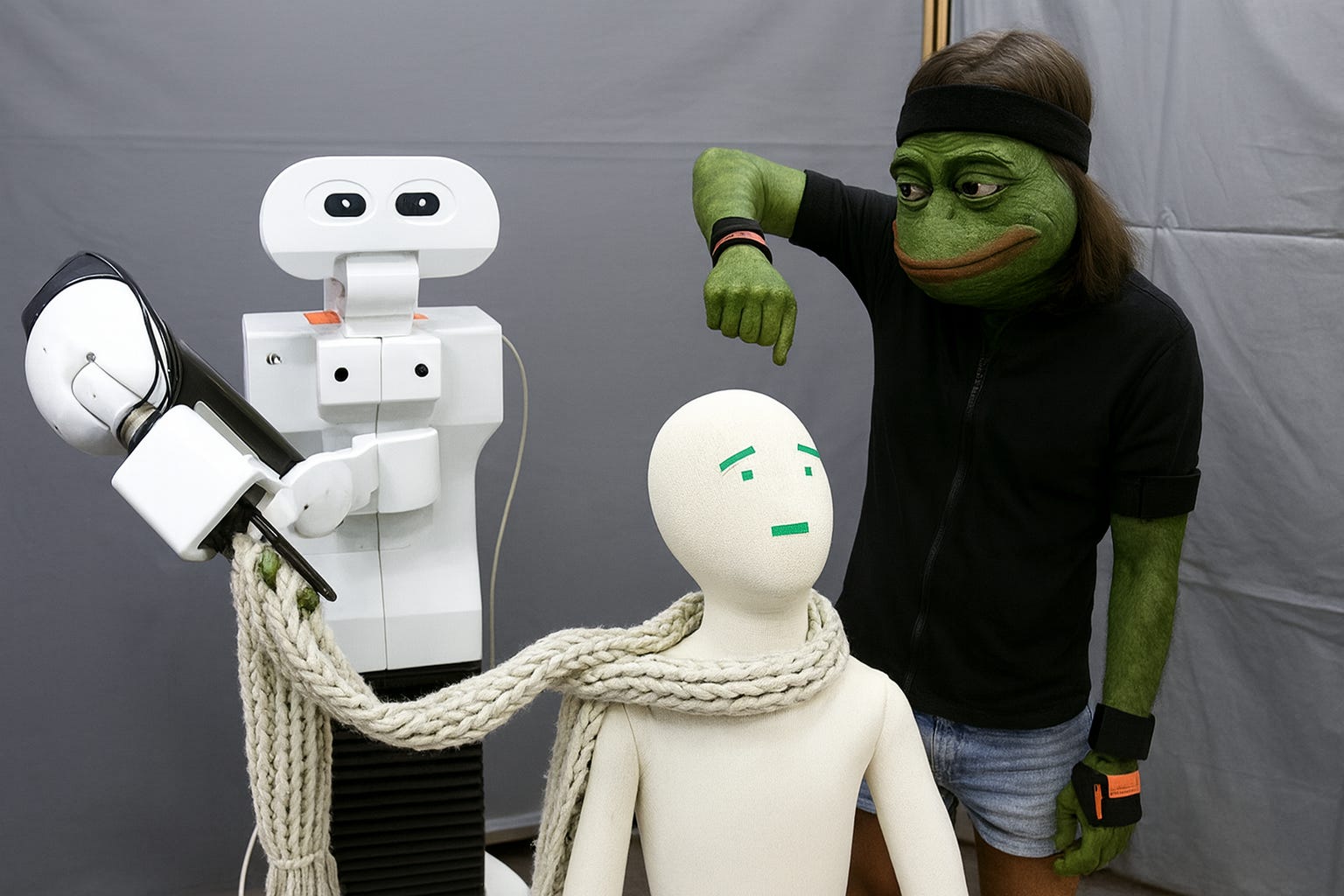
At its core, teleoperation means controlling a machine or robot in real time, from a distance. You send commands; it responds, streaming back data like video, audio, force feedback, or spatial position to help you steer.
Sometimes it’s low-level and manual: a joystick driving a bomb robot through a narrow hallway. Sometimes it’s high-level and hands-off: you set a goal, and the robot handles the execution. And in between, there’s something called shared autonomy, where a human and a robot work together, like teammates. The robot handles the easy stuff, and the human helps when things get tricky.
The key idea is simple: A robot doesn’t need full autonomy to be powerful. It just needs a reliable way for humans to stay in the loop.
Why It Matters
So what’s the point of all this?
Teleoperation might sound like a stepping stone until full autonomy arrives. But in practice, it’s become something much more foundational.
Because as much as we talk about building autonomous robots, the truth is… they’re not quite ready. At least, not for everything. Not yet.
And while the dream of controlling a fully functional Iron Man suit from your couch is still out of reach (for now), the real magic of teleoperation is already solving problems that pure automation can’t.
Here’s what teleoperation actually unlocks:
Safety in dangerous places
Some environments are just too risky for humans: bomb threats, toxic chemical spills, or nuclear cleanup. Instead of sending people in, we send robots, with a human safely controlling them from afar. It’s still a human judgment call, just without putting a body in harm’s way.Access to unreachable locations
Teleoperation lets us go where humans physically can’t. Deep-sea robots explore shipwrecks and offshore oil rigs. Mars rovers dig into alien soil. In both cases, a human is still behind the wheel, just separated by a lot of distance and a long data cable (or a satellite link).Less downtime, faster fixes
When a robot gets stuck, say, in a warehouse or hospital, a human operator can jump in, steer it past the problem, and hand control back to the system. No need to roll a technician onsite. No system reboot. Just keep things moving.Remote work, but for physical jobs
A heavy-duty mining truck doesn’t need its driver to be on-site anymore. Someone in a control center (or even a different country) can operate it remotely. That means more flexibility for workers, and fewer people in high-risk zones.Teaching AI by doing
Every time a human teleoperates a robot, it creates valuable training data. That data helps teach the robot how to handle edge cases and improve over time. It’s like giving the robot lessons until it’s ready to act on its own.
Teleoperation isn’t some temporary fix while we wait for smarter AI. It’s how we let humans guide robots through the messy, unpredictable parts of the world, and in doing that, help them learn. It’s a foundation.
But it’s also bigger than that. It opens the door to a new kind of work, where people can operate, train, and collaborate with machines from anywhere. And over time, it gives us a way to connect not just one or two robots, but thousands, even millions, all learning and working together.
Why Crypto in Teleoperation?
So far, we’ve seen how teleoperation helps bridge the gap between what robots can do today and what we want them to do tomorrow. But scaling that isn’t easy.
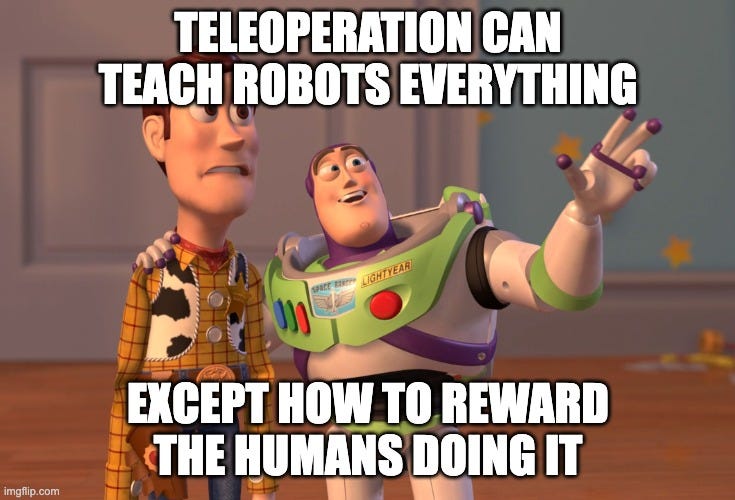
Robotics needs data. A lot of data. Not just images or text, but motion, feedback, edge cases, things only humans can really provide through hands-on interaction. That’s where teleoperation helps. But collecting that kind of data is slow, expensive, and hard to organize. That kind of data takes time, money, and, most importantly, people. Human input is essential, but today’s systems don’t make it easy to reward people fairly for helping out.
That’s why crypto makes sense here.
It gives us a way to track who did what, make sure the data is real, and reward people directly, all without being limited by one company or platform. This is more than tokens or hype. It’s about building a better system where anyone can contribute data, teach machines, or remotely operate robots, all while being fairly and transparently rewarded.
Different projects are approaching it from different angles: some are building hardware that lets people contribute teleop data, others are focused on the software to coordinate everything behind the scenes.
Let’s explore a few of them.
Reborn
Reborn AGI is teaching robots the way we’d teach a kid: by showing, not just telling.
Using tools like VR headsets, motion-capture gloves, or even your phone, people can control robots remotely and get rewarded with tokens for doing it. Every action you take, like moving an arm, navigating a space, or completing a task, becomes training data for the robot to learn from.
And they’re not just doing this in simulation. In one demo, a humanoid robot was remotely guided to perform medical procedures like listening to heartbeats and even simulating injections. It’s the kind of hands-on learning that robots just can’t get from code alone.
To make this all scale, they’ve built Reborn Nest, a sim environment where developers can test behaviors safely before taking them into the real world. It’s basically flight school for robots, and the learning goes both ways.
It’s a simple idea: let people teach robots by doing. But with the right tools and incentives, it becomes a powerful way to scale real-world intelligence.
PrismaX
While Reborn is focused on how we teach robots, PrismaX is zooming out to ask: what if that teaching was part of a whole new economy?
They’re not building robots themselves. Instead, they’re building a system where anyone, anywhere can control a robot, contribute useful data, and get paid for it.
It works like this: robot owners need help. Humans have the skills to guide robots. PrismaX connects the two through a plug-and-play platform where operators can jump in, control machines remotely, and help them learn. Every session creates valuable data, which feeds into AI training. And because it's built on-chain, everything is tracked, verified, and rewarded transparently.
Their protocol supports high-frequency control, real-time reward systems, and ultra-low-latency video, all designed to make teleoperation feel local, no matter where you are in the world.
As Chyna Qu, cofounder of PrismaX, puts it: “Teleoperation is critical for scaling robotics because the high-quality data traces collected through teleoperation allow robotics companies to train accurate models for commercially valuable use cases quickly, speeding up mainstream adoption of advanced robots. Teleop also becomes increasingly valuable as robot adoption increases; since robotics models will never reach 100% accuracy, every five or ten robots will need at least one human ‘pilot’, potentially employing tens or even hundreds of millions of people worldwide.”
If Reborn is a school, PrismaX is an economy.
Frodobots
FrodoBots asks a question no one saw coming: what if the best way to teach robots... was to let people play?
Instead of relying on trained robot operators, they let everyday people control real robots from anywhere in the world. Want to drive a rover through a maze? Pick up objects with a robot arm? Compete in challenges? You can, just like playing a video game.
But there’s something bigger happening behind the scenes.
Every move players make becomes data: the kind robots need to learn how to move, react, and make decisions in the real world. It’s not just for fun. It’s one of the most creative ways we’ve seen to collect large-scale, high-quality training data.
Frodobots is using play as a way to teach robots. Every player, every challenge, every small movement adds up to something bigger: helping machines understand how humans move, think, and solve problems in the real world.
NRN Agents
If FrodoBots is about collecting training data through play, NRN Agents is about turning that data into skills robots can actually use. They build AI agents in simulation, then transfer and refine them on real robots using teleop-generated data.
Where it gets interesting is how they get that data. NRN runs browser-based robotics competitions where anyone can jump in, teleoperate a simulated or real robot, and compete in challenges. Every match generates rich control traces, which is exactly the kind of behavioral data needed to train better pretrained skills.
Those skills are then loaded onto new robots, so humans don’t need to be involved every second, but just step in when something unusual happens. With continuous feedback loops, the system keeps improving, letting one operator manage many robots instead of just one.
GEODNET
Then there’s GEODNET. You won’t see them piloting robots, but they’re quietly making the whole ecosystem work.
Most GPS systems are only accurate within 5–20 meters. That’s fine for finding a coffee shop, not for landing a drone or navigating a tight warehouse aisle.
GEODNET fixes that with a global network of decentralized GNSS stations that provide centimeter-level positioning.
That level of precision is why FrodoBots partnered with GEODNET for their EarthRover remote controlled robots, built for AI training and real-world data collection. It’s one of the first affordable bots (starting at $199) to come RTK-ready right out of the box.
https://x.com/frodobots/status/1925174858897621239
And that matters. Because when you're controlling a robot from across the country, or across the planet, precision is everything. A drone landing on a rooftop or a delivery bot turning a corner can’t afford to be even a few inches off. Shaky signals lead to crashes, missed turns, or bad data.
GEODNET doesn’t do the remote control itself, but it gives teleop systems the spatial awareness they need to work safely and reliably. It’s the kind of invisible infrastructure that makes everything else possible: the map under the mission.
Conclusion
We often imagine the future as something distant: full of flying suits, talking machines, and robots that just “know what to do.” But the truth is, we’re already building the systems that make that future possible. They just look a little different up close.
Teleoperation isn't a small step to real autonomy. Rather, it’s the infrastructure layer where robots learn, adapt, and begin to collaborate with people in meaningful ways. It’s the point of contact between human experience and machine execution, and it’s where most of the real-world intelligence we take for granted is being transferred.
But for teleoperation to scale across robots, geographies, and industries, we need more than just interfaces. We need incentives. Verification. Coordination.
That’s why we’re seeing a new wave of projects stepping in to fill the gaps. Reborn, PrismaX, FrodoBots, and GEODNET are different pieces of the same puzzle, but they’re all working toward the same goal: making teleoperation actually work at scale. One is focused on how robots learn from people. Another is making sure those people get rewarded fairly. Others are solving how we gather better data, or how we keep everything grounded in the real world. It’s not one big breakthrough, but a bunch of quietly connected efforts starting to add up.
We’re not waiting for some Iron Man moment to arrive. We’re building the operating systems, the networks, and the incentive layers that bring robots online, as part of a connected, learning, human-in-the-loop ecosystem.
Because no matter how smart robots get, they still need us, not just to take the wheel, but to show them how to drive.
And the sooner we build for that partnership, the sooner these machines can truly learn to work with us, not just for us.
The suit was never the point. The system is.
About Conglomerate
Conglomerate is a seasoned content writer and KOL in the crypto x AI x robotics space. Web3 gaming analyst, core contributor at The Core Loop, and pioneer of the onchain gaming hub and Crypto AI Resource Hub.
Book A Call
Curious how robotics, gaming, and AI can drive your next growth wave? Let’s talk. Book a call with Crescendo’s BD lead Filippo